New community center opens amidst tensions

dsc08808The Jerusalem Post (print edition), March 5, 2010

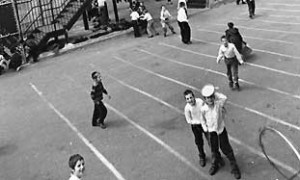
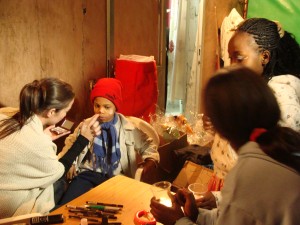
On Tuesday night, Africans, Israelis, and internationals marked the opening of a new South Tel Aviv community center with a Purim party, attended by the children of asylum seekers and kids from the neighborhood. Decorations, candy, and other sweets were donated by Hilit Insurance Agency, which specializes in offering its services to the foreign communities in Israel. Volunteers and employees of Mesila Aid and Information Center for the Foreign Community joined the festivities, painting the kids’ faces. The children were also amused with music and balloon animals, amongst other activities and performances.

In many ways, it seemed like the typical children’s Purim party. A rainbow of balloons dotted the walls and sugar-fueled kids dashed about, including more than one crown-wearing princess. A girl costumed as a ladybug buzzed by. A volunteer dabbed color on a little boy’s face, transforming him into a cat. Several girls looked on, chatting with each other and the volunteer in fluent Hebrew.

Continue reading “New community center opens amidst tensions”
Not illegal enough

03march08-002The Jerusalem Post, February 19, 2010

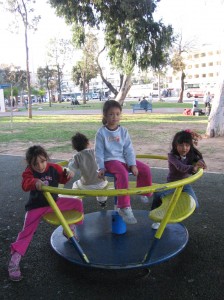
Like many Israeli students her age, Criselle, 16, is planning to travel with her class to Poland. Her journey isn’t without obstacle, however. Criselle, the daughter of Filipino workers, might be unable to re-enter Israel when she returns because she is without legal status.

Criselle is part of the approximately 1200 children of illegal migrants who face possible deportation at the end of the school year. But she is a unique case amongst them—Criselle is one of 30 children who, in the past, weren’t illegal enough.

In summer of 2006, when the Israeli government decided to grant permanent residence to some of the children of foreign workers and asylum seekers, Criselle’s parents rushed to apply. Criselle met all the criteria. She was raised here. She was above the cut-off age of four years and nine months. And, having attended Israeli schools all of her life, she was assimilated and acculturated.

But there was a catch.

Continue reading “Not illegal enough”

Poems after Auschwitz

showimageashxThe Jerusalem Post, February 12, 2010

In 2003, Newsweek ran an article titled “Poetry is Dead. Does Anybody Really Care?” Its author, Bruce Wexler, writes “It’s difficult to imagine a world without movies, plays, novels, and music but a world without poems doesn’t have to be imagined.” Why? According to Wexler, the “art form is dead.”

Wexler doesn’t wag his finger at poetry, rather he points towards society. In the 70s and 80s, he writes, American culture “became intensely prosaic.” “By the 90s,” he continues, “it was all over.” According to Wexler, impatience, lack of knowledge, and sheer laziness all contributed to the poetry’s demise.

And in autumn of 2009, the magazine apparently checked poetry’s pulse and found it still enough for Wexler’s article to be resurrected for the website.

Continue reading “Poems after Auschwitz”

Tel Aviv cools off

dsc08375

The Jerusalem Post, January 22, 2010

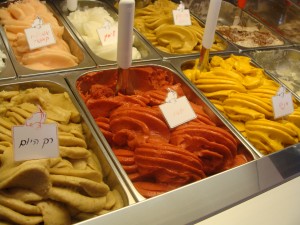
I first fell in love with ice cream in Barcelona. It was spring and I walked La Rambla—that grand, tree-lined avenue—with many a cone of milky espresso-flavored-dessert in hand. In Venice, I traipsed along turquoise waterways licking creamy almond gelato. And during summer in Alexandria, I cooled down every night with a walk along the Corniche and a smooth scoop of melon.

But it was in Tel Aviv that I ate enough vanilla-ginger to warrant a new pair of jeans.

In the past, Tel Aviv was best known for its sidewalk cafes and hummus joints. But recently, we’ve taken to announcing our place on the Mediterranean: we are here, and we’ve got ice cream.

And what ice cream it is.

The city is dotted with glideriot, ice cream parlors, like so many sprinkles on a sundae. After countless cups, cones, and tiny-sample-spoonfuls—and after sacrificing my waistline—I give you my six favorite spots.

Continue reading “Tel Aviv cools off”

Tel Aviv’s Egyptian grandmother

dsc08197The Jerusalem Post, January 15, 2010

The first time I visited Julie, I felt transported. I’d turned onto Shabazi Street in Neve Tzedek and, somehow, left Tel Aviv. I’d stepped into one of those classic Egyptian eateries—a humble kitchen turned bustling restaurant, tucked away on a nameless alley.

I stood at the counter before a dizzying array of open pots, breathing in the spices, listening to the Arabic music winding through the air. Owner Julie Ozon clapped in time, her gold bangles tinkling like bells. I looked from the moussaka topped with thick slices of eggplant, to fish in a spicy tomato-based sauce, to plump figs stuffed with ground beef. My gaze drifted to red bell peppers full-to-bursting with meat and rice, to artichoke hearts capped with a savory mix of beef and spices, then to moist rice spilling from zucchini.

There was more rice—fluffy piles of yellow, dotted with carrots and peas. Ozon pointed at another pot, which held a soft mound of white studded with bits of crunchy brown noodles. “This is orez with sharaya,” she said, using the Hebrew word for rice alongside the Arabic for vermicelli.

Cauliflower fashioned into crisp, lightly fried patties sat on the edge of the counter next to a colorful salad and homemade tehina.

Continue reading “Tel Aviv’s Egyptian grandmother”

It’s beginning to look a lot like Christmas

dsc08085

The Jerusalem Post, December 25, 2009

Zara’s display of a Christmas tree sparked controversy and anger throughout Israel last week. Following complaints from the public, the Spain-based fashion chain changed their window decorations, removing symbols associated with the Christian holiday and, in some places, adding candlesticks to mark the local holiday.

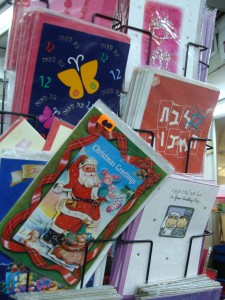
A post-chanukah stop at Tel Aviv’s Dizengoff Center found Zara’s windows empty of any winter cheer. But Christmas decorations were still about—HaKol Beh $, the dollar store on the ground floor, had a modest stock of Santa-decorated school folders, greeting cards, and bits of plastic greenery reminiscent of Christmas tree trimmings.

Pointing to the faux branches, owner Rachel Tzioni says, “I add them to my hannukiah. It’s pretty.”

In the past, such decorations were purchased mainly by foreign workers and Russian immigrants, Tzioni says. But in recent years, Tzioni has observed that a growing number of Jewish Israelis are stopping by her store to pick up a little bit of red and green for their home.

“It’s not our holiday,” she says. “But it’s another reason to party.”

Continue reading “It’s beginning to look a lot like Christmas”

Don’t give up the fight

dsc07992

The Jerusalem Post, December 18, 2009

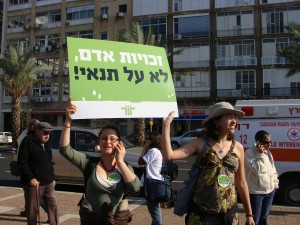
Led by over one hundred NGOs, thousands of people gathered in Tel Aviv on Friday to unite under the banner of human rights. The rally, organized by the Association for Civil Rights in Israel (ACRI) and timed to coincide with International Human Rights Day, centered on the theme “en matsav!” (no way!). The slogan was intended to express the idea that the erosion of democracy and infringement of human rights is always unacceptable, in any circumstances.

In a public statement regarding the demonstration, Yael Maizel of ACRI said, “They tell us human rights are a luxury for peacetime. They tell us not to be naïve, that security comes first…. We need to remind Israeli leaders and the general public that there is no security without human rights; that there is no way we will tolerate racism and discrimination in our communities and that we will not allow our democracy to fail us.”

Continue reading “Don’t give up the fight”

A series of Jewish encounters

1244509835maimonides1

The Jerusalem Post, December 18, 2009

In the spirit of Jonathan Rosen’s The Talmud and the Internet, the Jewish Encounters Series marries subjects that readers might not expect to see between the covers of one book.

“The series knits together different impulses,” Rosen, creator and editor, comments.

A joint imprint of Nextbook and Schocken, Jewish Encounters began eight years ago as an initiative to bring classic works of Jewish literature to American libraries. The enterprise quickly morphed, however, into a dynamic project that offers history, biography, and culture “filtered through a contemporary sensibility,” Rosen says.

“We’re engineering encounters between Jewish writers and subjects,” Rosen explains. “They’re personal encounters—and the writer’s journey is part of the reader’s journey.”

Continue reading “A series of Jewish encounters”

Trauma unit

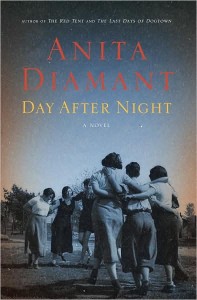
day_after_night Review of Anita Diamant’s Day After Night
Haaretz, December 4, 2009

After the darkness of the Shoah, in the last days of the British Mandate, waves of Jewish immigrants flooded Palestine’s shores. Their numbers far exceeded the quotas set by the British, and these new arrivals — most coming by boat from Europe, a few traveling by foot from the Arab world, but all of them considered illegal — were rounded up and sent to detention centers in Palestine and Cyprus, where they waited for the British to decide their fates. One such internment camp, at Atlit, just south of Haifa, serves as the setting for Anita Diamant’s latest work of fiction, “Day After Night.”

Atlit, Diamant writes in the opening pages, “offered a grim welcome to the exhausted remnant of the Final Solution, who could barely see past its barbwire fences, three of them, in fact, concentric lines that scrawled a crabbed and painful hieroglyphic across the sky.” She draws on first-hand reporting for this description — a 2000 visit to Atlit, today a museum, gave her the idea for the novel.

Diamant is best known for “The Red Tent” (1997), which became an international bestseller. That book, in which the author took as her premise the biblical story of Jacob’s daughter Dinah, recasts Dinah’s woeful tale as one of feminine strength and triumph.

Continue reading “Trauma unit”

White city, black days

whitecityblackdays1White city, black days

The Jerusalem Post, October 2, 2009

Earlier this year, the festive pop and bright flash of fireworks marked the beginning of Tel Aviv’s centennial year. But the celebration was held at Rabin Square – a location that reminds Israelis that, amidst the excitement, there is a sober history to commemorate, as well.

Those dark days of Tel Aviv are the topic of a current exhibition at the Eretz Israel Museum, titled “White City, Black Days.” Comprised primarily of photographs, the exhibition is divided into waves of difficult times that the first Hebrew city has faced from World War I to the present. Though many of these events have long passed, some have left an indelible mark on the city’s urban landscape, and some continue to resonate deep within the Israeli psyche.

Continue reading “White city, black days”